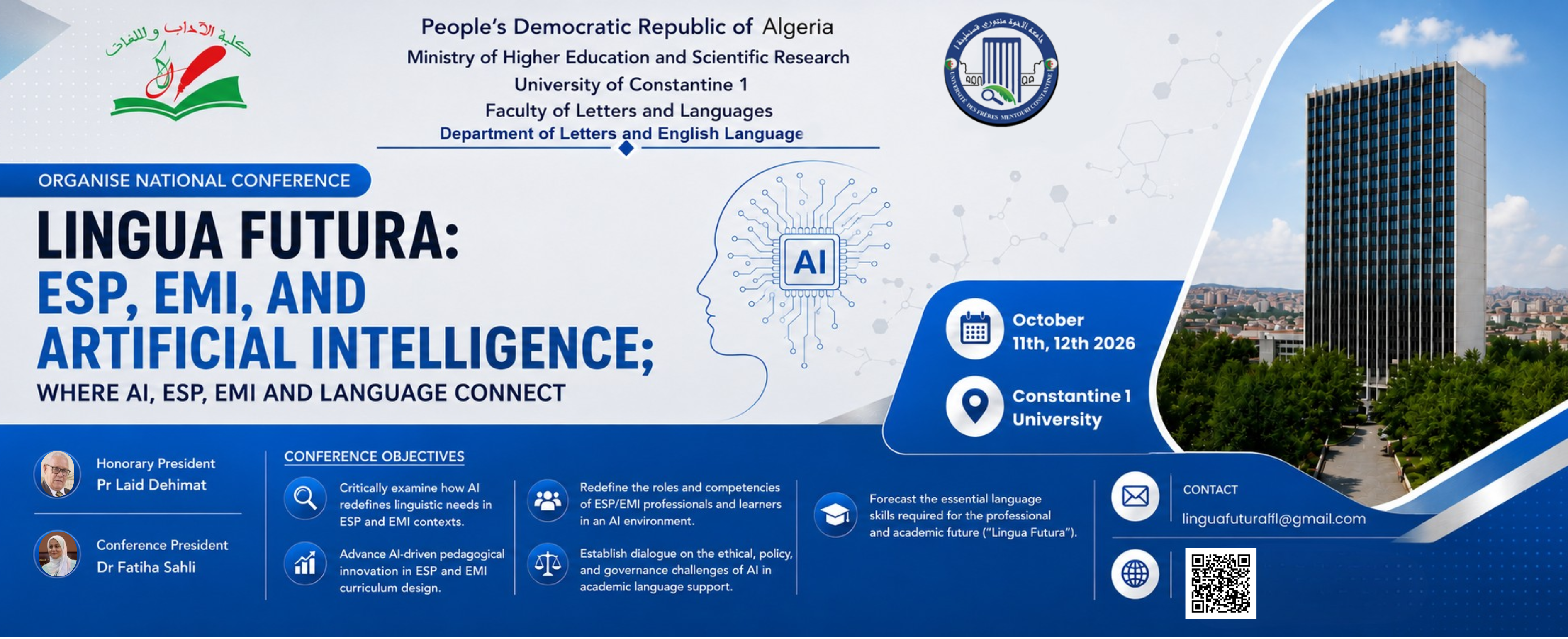
Introduction
The pervasive integration of Artificial Intelligence (AI) is not just an
incremental technological update; it is a fundamental shift reshaping
professional practices, academic delivery, and human communication itself.
As this paradigm evolves, the fields of English for Specific Purposes (ESP) and
English as a Medium of Instruction (EMI) find themselves at a critical
intersection. Historically, both ESP and EMI have focused on preparing
learners for real-world linguistic demands—be it the specialized discourse of
a profession (ESP) or the content delivery in an internationalized academy
(EMI). Now, these "real-world demands" are rapidly being redefined by
machine capabilities
This conference, Lingua Futura: ESP, EMI and Artificial Intelligence, is
dedicated to exploring this emergent triad. We move beyond simple
questions of tool adoption to critically examine how AI is transforming the
core knowledge, skills, and pedagogical models of language and content
education. AI offers unprecedented opportunities for personalized learning,
automated feedback, and access to vast, domain-specific linguistic data.
Simultaneously, it presents challenges to traditional language roles,
introduces ethical dilemmas regarding academic integrity and data privacy,
and demands a fundamental re-evaluation of what constitutes effective
teaching and learning in a language that is increasingly mediated and
generated by algorithms.
We invite scholars and practitioners to join a crucial, forward-looking
discussion. Our goal is to forge a path that not only adapts to AI but actively
leverages its power to design a more effective, specialized, and equitable
language education future. As noted by Lee and Lee (2023), the effective
integration of these technologies requires a shift from viewing AI as a
supplementary tool to recognizing its role as a "coconstructor of meaning" in
professional and academic discourse.
Objectives of the Conference
- Critically examine how AI redefines linguistic needs in ESP and EMI contexts.
- Advance AI-driven pedagogical innovation in ESP and EMI curriculum design.
- Redefine the roles and competencies of ESP/EMI professionals and learners in an AI environment.
- Establish dialogue on the ethical, policy, and governance challenges of AI in academic language support.
- Formation des enseignants de langues dans les contextes scientifiques et techniques
- Forecast the essential language skills required for the professional and academic future ("Lingua Futura").
Tracks
- AI-Enhanced Needs Analysis & Curriculum Design: AI in diagnosing specific language needs and developing custom ESP curricula.
- Generative AI in ESP/EMI Content Creation: Utilizing Large Language Models (LLMs) to generate discipline-specific materials and learning resources.
- Intelligent Tutoring and Adaptive Learning: Developing and evaluating AIdriven systems for personalized ESP and EMI practice.
- AI, Assessment, and Academic Integrity: Tools for automated evaluation, feedback, and managing AI-generated output and plagiarism.
- Corpus Linguistics in the AI Era: Using AI and Natural Language Processing (NLP) for advanced professional discourse analysis and corpus building.
- EMI Instructor Development & AI Literacy: Training and upskilling content and language teachers in the effective and ethical use of AI.
- EMI Instructor Development & AI Literacy: Training and upskilling content and language teachers in the effective and ethical use of AI.
- Policy, Ethics, and Governance: Formulating institutional guidelines, addressing bias, and ensuring equitable access to AI tools.
- AI and Multilingualism in Higher Education: The role of AI in supporting translanguaging practices and balancing EMI with local languages.
- Professional Communication and AI: Investigating how AI reshapes workplace communication, specialized tasks, and the demand for soft skills.
- The Future of Human-AI Collaboration: Conceptual studies on the long-term impact of AI on learner autonomy and the evolution of specialized language competence.
Submission Guidelines
Abstract submissions should be no more than 300 words. Submissions can be in English/ French / Arabic / Espagnol
Important Dates
Abstract Submission Deadline: Septembre 1st, 2026 Notifications of Acceptance:Septembre 30th, 2026 Conference Date: 21 & 22 Of October, 2026
Scientific Committee
President of the Scientific Committee : Dr Khelloufi NourElhouda
- Pr. Nacif Labed – Constantine 1 University
- Pr. Riad Belouahem – Constantine 1 University
- Pr. Beghoul Youcef – Constantine 1 University
- Pr. Leila Kara Mostefa – Chlef University
- Pr. Hayette Messakhar – ENS Bouzaréah
- Pr. Linda Abdelouaheb – M'Sila University
- Dr. Rafik Fadel – Constantine 1 University
- Dr. Mohamed Boukazoula – Jijel University
- Dr. Kaddour Hammal – Mostaganem University
- Pr. Fouzia Amrouche – M'Sila University
- Pr. Sarah Merouche – University of Oum El Bouaghi
- Pr. Lamri Segueni – University of Biskra
- Dr. Ouafa Ouarniki – University of Djelfa
- Dr. Djelloul Bourahla – University of Ouargla
- Pr. Radia Boughebs – ENS Constantine
- Dr. Mounira Tabdjoun – Constantine 1 University
- Dr. Khelil Boumaza – Constantine 1 University
- Dr. Azzedine Habira – Constantine 1 University
- Dr. Rym Kemmouche – Constantine 1 University
- Dr. Amira Halim – Constantine 1 University
- Dr. Chahinez Benelmouffak – Emir Abdelkader University
- Pr. Malika Benkherchouch – Constantine 1 University
- Dr. Fouzia Rouaph – Setif 2 University
- Dr. Lilia Boumendjel – Constantine 1 University
- Dr. Mahdi Aberkane Bendiab – Constantine 1 University
- Dr. Amira Benabdelkader – Constantine 1 University
- Dr. Salah Eddine Sadouni – Constantine 1 University
- Dr. Leila Djouimaa – ENS Constantine
- Dr. Fatima Hamadouche – Constantine 1 University
- Dr. Naoual Bouchareb – Constantine 1 University
- Dr. Saliha Beleulmi – Constantine 1 University
- Dr. Meriem Bousafssaf – Constantine 1 University
- Dr. Lamia Ouamer – Constantine 1 University
- Dr. Saoussen Madoui – Constantine 1 University
- Dr. Imene Benkhlifa – Constantine 1 University
- Dr. Mounira Derouag – University of Batna 2
- Pr. Nacira Ghodbane – University of Batna 2
- Dr. Rym Ghost Bel Chelbi – University of Ouargla
- Dr. Hamza Benamer – Mila University
- Dr. Maroua Benhamlaoui – Constantine 1 University
- Dr. Loubna Benrabra – Oran 2 University
- Dr. Soria Mezhoud – ENS Constantine
Organizing Committee
President of the Organizing Committee : Dr Hafiane Sandra
- Dr. Bilel Sebaihi – Constantine 1 University
- Dr. Hamza Bouketir – Constantine 1 University
- Dr. Mahdi Mechta – Constantine 1 University
- Dr. Kaouther Boudjemaa – Constantine 1 University
- Dr. Soumia Aouati – Constantine 1 University
- Dr. Salima Selmen – Constantine 1 University
- Dr. Naima Eutamene – Constantine 1 University
- Dr. Manel Moulem – Constantine 1 University
- Dr. Samiha Assas – Constantine 1 University
- Miss Hanane Nouar – Constantine 1 University
- Miss Amani Boudada – Constantine 1 University
- Miss Khadra Yasmina Meridja – Constantine 1 University
- Miss Tahani Baya Achi – Constantine 1 University
- Miss Amani Bouzaa – Constantine 1 University
- Mr. Sohaib Zaatri – Constantine 1 University
- Miss Ghofran Laouar – Constantine 1 University
- Miss Hadia Sidi Mansour – Constantine 1 University
- Miss Imene Sandra Benlaouar – Constantine 1 University